Compost vs Landfill: Does it Really Make a Difference?
Last week I wrote a post about curbside composting programs that some cities have started. One of the benefits of keeping compostable food out of landfills, I wrote, is that it reduces landfill methane - a greenhouse gas that is 72% more powerful than carbon dioxide.
One of the readers, Dean, posed a question in the comments.
Does this actually reduce methane emissions? It seems, based on the lack of detail in the article, that the same amount of methane would be produced whether the organic waste was sitting in a compost pile or a landfill. Why wouldn’t that be true?
This is a good question, and I thought it deserved to be answered in a post instead of just a reply in the comments section.
- » See also: Rehabilitating Bio-Fuels Part 2: Interesting Second Generation Options
- » Get Sustainablog by RSS or sign up by email.
Landfill methane is a gas that is produced in a landfill because the things in the landfill undergo anaerobic decomposition. Basically, this means that because municipal solid waste that is buried in a landfill does not receive oxygen, it will produce methane.
A compost pile, on the other hand, undergoes aerobic decomposition. Because it is exposed to oxygen, either by turning it or through the use of worms and other living organisms, it produces CO2 (carbon dioxide) instead of methane.

Of course, not all compost piles are treated the same, so some attention needs to be paid to the compost pile to so that it receives the oxygen that it needs. But, if a compost pile is being taken care of properly, it will produce far less methane than a landfill.
This is a very basic answer, but I think it should answer the question as to why food waste is better off in a compost pile than in the local landfill.
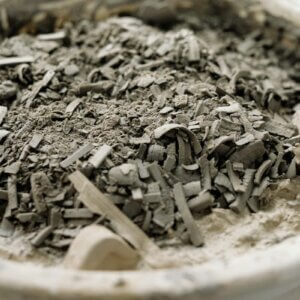
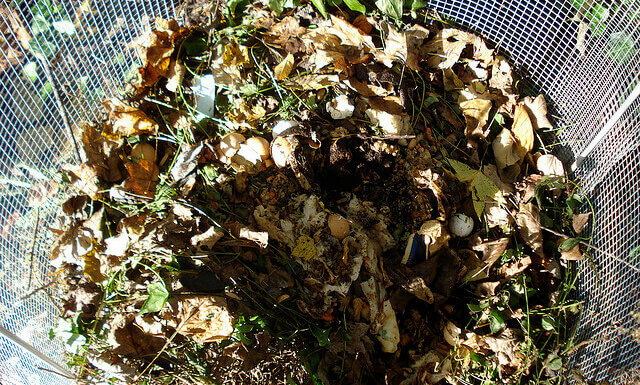
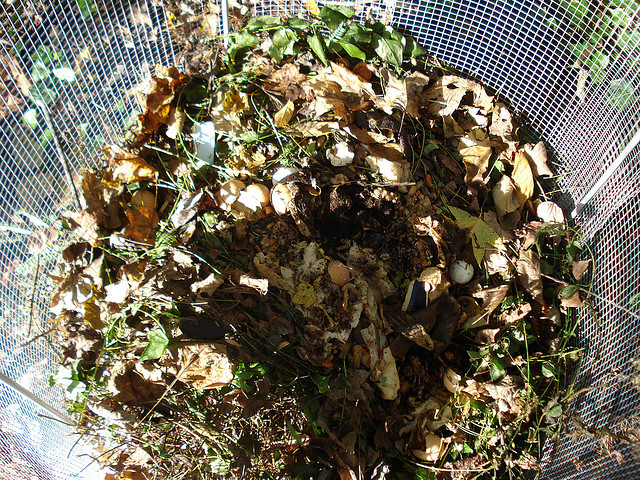
Image courtesy of D’Arcy Norman on flickr


It is a fair question - for my masters thesis I decomposed various organic materials and measured the CO2 released. Generally, wetter composts are more likely to go anaerobic than drier ones. Later I considered this on a bigger scale when I worked on large industrial compost windrows. At this scale it is very difficult not to have some of the compost becoming anaerobic and releasing methane. This is generally linked to the carbon:nitrogen ratio of the constituents of the windrow, and as carbon rich materials are expensive. You get a massive burst of methane released every time you turn the windrow.
The main difference with a landfill is that in a landfill all the organic materials and inorganic materials are mixed in an unholy mess, whereas at least you know what you’ve put into a compost windrow. The chances of weird mixtures of breakdown products are therefore much higher, never mind the imperfect conditions for the organic matter to breakdown leading to extra methane production.
That said, this is bucket science on a grand scale - and compost sites are very common causes of odour complaints, mainly due to poor oxygenation.
Thanks for that. It is also important to note that compost also can be sold or used in city programs, whereas landfills are covered over and can produce problems if built on. We had an issue of this in Cleveland!
I still don’t think its so cut and dried…
Firstly, curbside composting doubles the carbon footprint for garbage collection. Instead of one giant diesel truck lumbering through your neighborhood every week, you now have two: garbage truck and compost truck.
Secondly, a poorly maintained compost heap could be worse than a well maintained garbage dump. Some well maintained dumps inject oxygenated water into their systems, reduce methane, and speeding up decomposition. Really high-tech dumps can recover the methane, and turn it into fuel.
On average, composting is probably better… but in highly green states on the west coast, odds might be that the dump is greener than centralized composting.
Although, both are less green than home composting.
Hey Robin,
Thanks for clearing things up. Makes perfect sense now. Even if both were comparable, composting provides a resource that garbage trucks take away to remote locations. But, not everyone grows their own food, so not everyone understands the value of so-called “trash”.
Who knows? In the future, we may have deposits placed on all sorts of inedible, organic material, just as some places have them on recyclable materials now. It seems like a no brainer for metropolitan areas that have to transport trash over relatively long distances to an accepting disposal site.
“A compost pile, on the other hand…produces CO2 (carbon dioxide) instead of methane.”
Whoa! Hold on a minute! Do not the greens claim that it is atmospheric CO2 (a by-product whose only origins are the activities of western man) that is the primary cause of global warming? Isn’t opting to manufacture CO2 via composting in lieu of producing CH4 in a landfill simply trading one evil for another?
The other issue with composting is as with recycling of plastics, metals, paper and so on - even if there are no emissions or energy reductions as a result, we save on physical resources.
Organic material provides fertility to land. If you export that fertility (eg a farmer selling their food) then you must replace it. You can replace it with natural material (compost) or with artificial material (nitrogen fertiliser made from natural gas, etc). This is the reason that farmers would burn the stumps of their crops, put animal manure on the land, and so on.
If we put organic material in landfill, its fertility is lost to us. Mixed in with plastics and metals and so on, the land will be poisonous and you can’t grow food there. But if you compost the stuff you can return it to agricultural land and help you grow food.
“Isn’t opting to manufacture CO2 via composting in lieu of producing CH4 in a landfill simply trading one evil for another?”
Bobby, not exactly. It’s choosing the lesser of two evils.
Organic material with 1 unit of carbon in it will produce either 1 unit of CO2 or 1 unit of CH4. But 1 unit of CH4 has over twenty times the warming effect of 1 unit of CO2.
Whatever you do with organic materials you will get some greenhouse gas emissions. The only question is whether it’s emissions with a relatively strong or relatively weak effect. So we can have something which produces 1 unit of warming, or 20+ units of warming. There is nothing we can choose which is 0, we have to choose between 1 and 20+.
It’s trading a lesser evil for another. Which is not too bad.
Which of course you could have found out in five minutes with google. Alas, denialists are less keen on research and more keen on drive-by comments.
Kiashu - Thanks for resorting to name calling to tag me a “denialist”, although I personally prefer the term “skeptic”. Also, I am well aware of the claim that CH4 = 20X the warming effect of CO2 (nice try at the stupidity angle). However, most in the modern green crowd have chosen to demonize CO2, not CH4. In the purest sense of greenism, isn’t accepting any form of evil wrong?
A sceptic questions, and looks in detail at answers given. A denialist simply denies, and continues denying regardless of the answers given.
There is no “purest sense of greenism”. “Green” is like “Labour” or “business” or whatever, it’s simply a statement of what the person thinks is most important in shaping our policies.
It’s impossible for us to have no effect on the world we live in. All we can do is to ensure that if our effect is not positive, it is at least as small negative as possible.
I appreciate that it’s much easier to win arguments when you respond not to what people are saying, but to some other stuff you made up yourself. Don’t be ashamed, that’s an old technique, done as far back as the Socratic Dialogues - where both Socrates’ words and those of his opponents were written by Socrates, unsurprisingly he won all those arguments.
No greenie over the age of 14 has ever said that any CO2 at all is wrong. Many are foggy on the details, but all understand that even just breathing produces CO2. We can’t hope to have zero impact on the environment, only to have a positive impact in some areas to balance out a minimised negative impact elsewhere.
If you contend with what people actually say rather than stuff you made up yourself, your conversations will be much more productive. That is, if you actually want productive conversations where people exchange ideas and learn from one another. Alternately, you may just want to be like Socrates and say, “haha! i r teh winnah!”
Is the best thing to do- put the garbage in a bag and bury it in a landfill? massively reduced emissions
I know, there are probabaly caveats, but this is the whole problem with this conversation. What we need is a serious study with serious numbers. This has a quantifiable answer, but all I here are guesses
Actually, Ben was the one who asked the great question. I just promised to search for the answer. Looks like you beat me to it.
Fortunately, I do have something to add to the discussion. You are absolutely right, the difference is that Carbon Dioxide is better than methene. Not only is methane a serious greenhouse gas, it is highly explosive. THAT is why landfills are now required to take precautions that the methane gas can be caputred (though the methane gas can be used/resold after capture).
Home composting is a great way to go. Municipal composting is great. Let’s face it, people willing to compost at home make up a small minority of folks. This isn’t likely to change any time soon. Commercial composters have a great incentive to get it right — if they don’t and the compost goes anerobic, it reeks (and they risk getting shut down).