
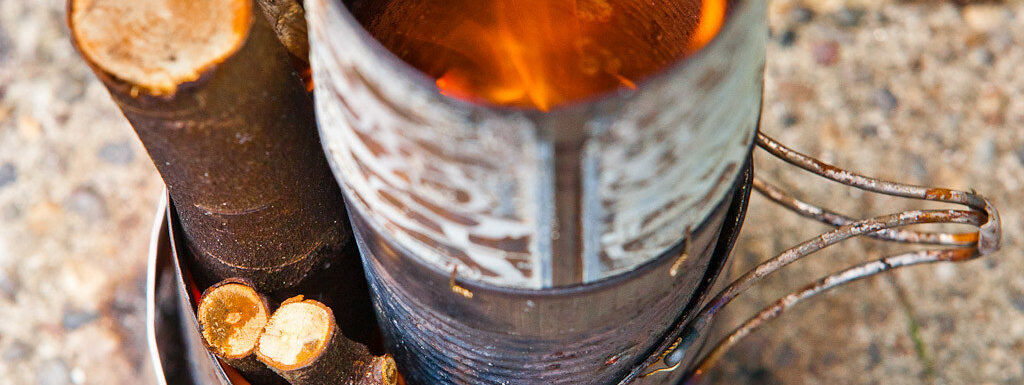
Just back from a weekend trip up to the Dancing Rabbit Ecovillage, and between board meetings, was able to join in with the community’s annual open house and Village Fair. Many, many interesting things going on, but one of my favorites (given my interest in appropriate technology) was a stand selling popcorn popped on a rocket stove.
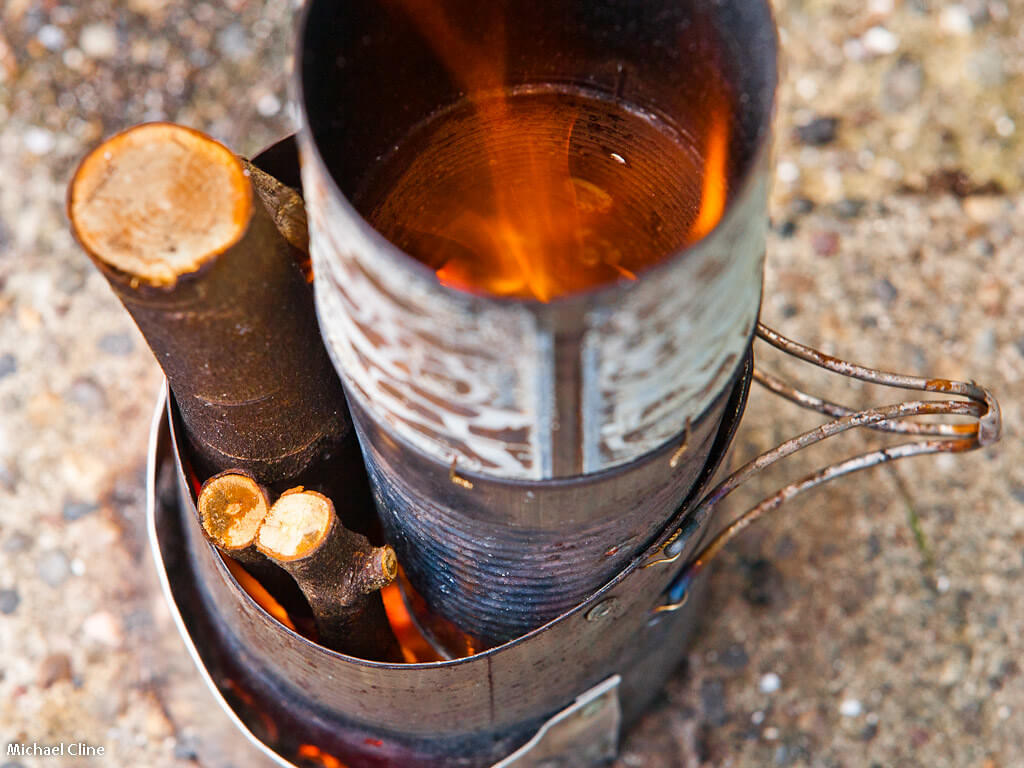
I’m really intrigued by this beautifully simple concept, created by Dr. Larry Winiarski. The stove was designed for clean cooking in the developing world (where wood smoke fires cause millions of deaths, as well as a huge contribution to deforestation), but strikes me as a tempting project for the DIY-er (even with limited skills — shoot, I’m even thinking about trying this out). I started doing a little research when I got home and discovered that there’s a kind of “open source” movement around the rocket stove: many people have shared their designs for these super efficient, super clean wood-burning stoves.
7 DIY Rocket Stove Plans To Consider
Looking for an alternative to the traditional outdoor barbecue grill, or even for heating your home (at least partially), I came across a number of plans that look eminently practical for the weekend tinkerer.
Very Simple 16-Brick Rocket Stove
This one requires no more than stacking some bricks… though I’m guessing they would need to be made of a material like adobe (for the insulative properties). That the stove’s creator, Dr. Winiarski, putting this one together.
Single-Pot DIY Rocket Stove
For this plan, you will need just a few more materials from the Aprovecho Research Center, but it’s still pretty simple. With materials that can either be found around the house or that are pretty accessible, this plan makes sure you’re ready to make a stove wherever and whenever.
DIY Brick Rocket Stove
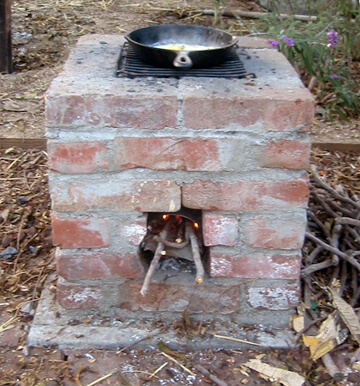
If you’re interested in something closer to the look of a conventional barbecue grill, this plan by the folks at Root Simple may be just the ticket. It’s a bit more involved than stacking bricks, but likely still within most of our skill sets.
Steel Drum Rocket Stove Heater
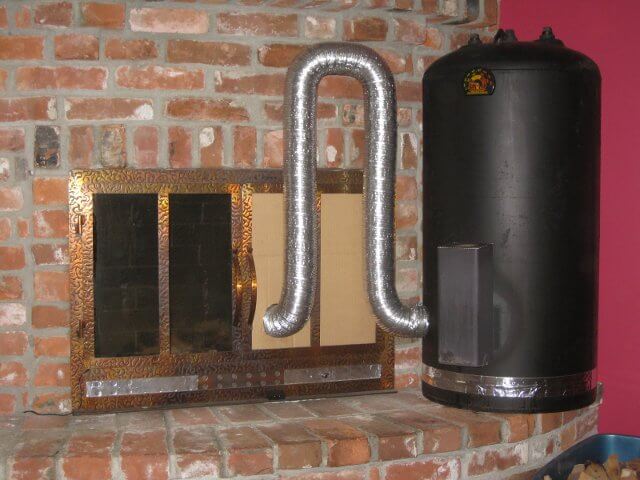
Welding is definitely beyond my abilities, but if you’re handy with a torch (or know someone who is), check out this DIY rocket stove for indoor heating. Of course, make sure to follow the author’s safety precautions for operation, and consider his suggestion that such a stove could have implications for your homeowner’s insurance. (via Lifehacker)
The Tin Can Rocket Stove
Yep, still looking around, and came across another really simple plan for a rocket stove made from tin cans. Jim Bonham, who made the video, has another one with some updates, and another (shorter) one on some of the safety issues involved in making this particular stove.
The “4 Block” Rocket Stove
This one’s even easier than the 16-brick stove at the top, and (at the time of the video’s publication two years ago) cost just over $5. Want a permanent stove in the back yard that takes five minutes to construct? This is the plan you want…
Know of other practical DIY rocket stove plans? Let us know about them in the comments.





























The first picture, of the larger brick rocket stove, with seven layers of brick, on “6 plans to build a rocket stove”, do you have some directions? How many bricks, or a little advice?
Thank you,
Barbara Harvey
Hi, Barbara–
I don’t, but I think it’s pretty much the same as the one in the first video.
Can the bricks be made of cement ? The ones used for sidewalks…
I don’t see why not; cement provides a good insulating factor. I don’t know how well it stands up to the heat, though…
From what I understand you need adobe or fire bricks. Cement can explode when it gets too hot.
That’s very good to know…!
Ever been to a fire, next time there is a fire drive over after it is out and look at the bricks.
Concrete is very porous and can hold alot of moisture, which will make it pop and crack apart when heated to a high temp. Also, you can and will get hit by the hot concrete schrapnel.
Ya will never get the cement blocks hot enough to explode with that little fire it take much more heat to explode a block.. ive got tonthe point get a good base n have an oil drip just to see what it take n ive yet to have one pop
NO ! I will tell you why cement bricks hold water and when taken to high temps. they break some times popping and sending chunks flying. Your best bet is to use fire bricks they cost a little more but will taker hi temps…and are a lot safer if you have kids around you don’t want to hurt them..
I’ve looked at several designs on the Rocket Stove. My friend in Oak Ridge, TN built one out of stainless steel and both he and his wife rave about it. I haven’t seen it yet, nor any rocket stove, but look forward to seeing it in operation. My observation of various plans revealed to me that the rocket stove is nothing but an old “Hobo Stove” with an added “J” or “L” insulated chimney inside; having either an open or closed top and exhaust. It appears to me that this would help many homeless people on the streets or jungling out in some improvised camp!
The rocket stove sure isn’t rocket science, but sheer brilliance! I’m searching out any full info on running rocket stove heat through a 700 sq ft mud floor (yoga studio/gallery space). Is there a lead out there on this? I’d like to have the stove outside and the piping (as narrow diameter as possible) throughout the floor, so none of the interior space is occupied with the system. This is an exciting road of discovery! I look forward to a response directly to my email address (please and thanks) dianesmith.silk@gmail.com
DS
I have read that South Koreans used an under the floor heat system like you describe. Perhaps a google search would help.
2 weeks ago I’d never heard of rocket stoves, today I build one from sixteen bricks and cooked my families dinner on it al I can say is WOW! Almost no smoke, great heat 1 hour of cooking on just a few twigs and dry branches (roughly measuring a supermarket shopping bag quarter filled). I’ll be trying out every example you mention until I’m cooking, heating my house and warming our water (different website :)) on them! It’s so great to find something that can do this using natures leftovers and not damaging the environment any more than necessary!!
Thanks so much for sharing your experience with us, Debbie – please let us know about your future efforts!
All foods can not be cooked on High.Is their a method of controlling the Temp(s) like a Damper?
Not that I know of, Jerry… but there may be more advanced models of which I’m unaware.
Restricting the incoming air flow will slow the heat down, but it may make the stove smoke more. Using the stove to make charcoal from the embers could solve any smoke problem. Pushing something in front of the intake should work – it’s time to experiment!C
I plan to make one that is front loading aut of a 5 gallon bucket and some soda bottles to form the adobe. It’s really cheap to do it that way.
“Check out my Survivalist Blog at the Clever Survivalist and read daily Survival Guide content.”
Good design on my third RMH. We run them all day long in the mountains. I came across this video on You Tube https://www.youtube.com/watch?v=20fY0eAP4iE Look like these guys are making shippable cores. Any one heard of http://www.dragonheaters.com?
I need to heat my small green house for 4-5 months, what kind of rocket stove design should I use ? must build within the next few days
I have a friend that had one installed and I think it was installed incorrectly. Whenever he starts a fire there is smoke everywhere. How to you stop this from happening?
Here’s five: http://www.youtube.com/playlist?list=PLTxZw4f6nzSFK6i6z5SMsBa4BQ_p2tEl1
Thanks for sharing, Leon – I’ll make sure to watch all of these!
Root Simple has a new design:
http://www.rootsimple.com/2012/03/a-rocket-stove-made-from-a-five-gallon-metal-bucket/
We’ve also made a couple different designs in our yard:
http://homesteadlaboratory.blogspot.com/2014/01/pocket-rocket-stove.html
http://homesteadlaboratory.blogspot.com/2014/08/dakota-rocket-silo.html
For more iterations on the first one, search for ‘Pocket Rocket Stove,’ and on the second one, I’ll add that it’s more convenient with a taller chimney than two blocks.
Thanks for sharing, Jake – I’ll check them out!
That online tool is pretty awesome. There are so many ways to build a rocket stove!
Here that worked for me! Made a rocket stove out of 6″ stove pipe. Added about 6 extra inches for inlet and a 1.5″ for the chimney. It has an excellent draft and works super good!
This is the picture
That’s a great design. I love the fact that rocket stoves are so sustainable. Green Home Designs
Without a proper pot skirt you get marginally cleaner combustion but no significant fuel savings.
Your blog is very informative. I have solved my many problems with the help of your articles. In the way, you write is very amazing, it increases my interest and I read more and more. Thanks.
Rocket rack made with floor heating.
http://m.youtube.com/watch?v=_ZqbtCemIaw
This is what a rocket stove built by me looks like:
https://www.youtube.com/watch?v=5fqhMY2OaX0&t=10s
Two models of rocket stoves made by me very useful:
https://youtu.be/5fqhMY2OaX0
https://youtu.be/QeGO1XrtMuk
Hi, I’m interested in plans for rocket stove and oven, is there a link to printable instructions? Thanks.
Check the plans themselves, Lisa: we’ve collected plans published by others here.