 Perhaps no one knows better than I do what it means to take individual responsibility for my environmental impact. For those of you familiar with my blog, you know that for the past three months, I have been trying to live 100% environmentally sustainably within urban Pittsburgh. A formidable task, indeed.
In Robin Shreeve’s provocative article, “Whose Responsibility is Sustainable Consumerism?”, she champions the youngest generation’s recognition that the responsibility for our actions lies with us individually, not mainly with corporations. Three months ago, I would have toasted to her conclusion. (Of course, I then believed we don’t need corporations whatsoever and we could live without them and be sustainable.) Today, however, my reaction to Robin’s article is different. I’m inclined to deeply disagree.
During the sustainable living experiment called the Sust Enable Film Project (which concludes by midnight today), I would argue that I succeeded in living sustainably less than a dozen days of the 3-month project. Does this fact disappoint me? At first, it did. But I will tell you why my experiment failed.
There are systems in the United States–for getting food, for getting rid of our trash, for flushing away our body wastes–that collectively (and historically), we have all agreed to adopt and abide by. They seem(ed) like the best solutions for problems we all face, and as a society (through the government) we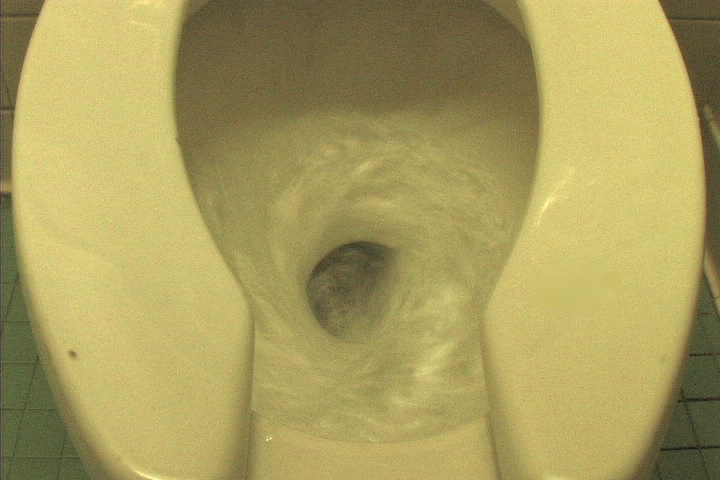 reinforce these systems. This was clear to me every time I flushed a public toilet, and another huge chunk was subtracted from my sustainable water use for the day. This became even clearer when I learned that many sustainable living methods–such as dumpster diving, squatting, and building a composting toilet–are outright illegal in many towns.
Doing something illegal (like dumpster diving) if it seems right to you… that’s one thing. Civil disobedience: often harmless, functional, and a true expression of freedom. There’s nothing wrong with that. But going hungry because the society-subverting alternatives are more difficult, demanding or have greater consequences than the unsustainable, mainstream options?
That is unacceptable. That is downright dangerous to the individual. I’ll take environmental unsustainability any day over risking my own immediate health. Do I think that environmental sustainability is intimately tied up with the health of an individual and a society? Absolutely! Do I think that this fact practically manifests in our world today? Unfortunately… no. That’s what Sust Enable has taught me. Such risks to self and sanity define what it’s like to try to live truly sustainably in the U.S. in 2008.
I sincerely doubt whether any product produced for the U.S. mass market today is produced sustainably. Even William McDonough and Michael Braungart, the authors of Cradle 2 Cradle: Remaking the Way We Make Things, admit that their optimistic scheme for a world in which there is no waste (a constant cycle of “biological” and “technical” nutrients) is not actually realistic in terms of the knowledge available in 2008. One of their prototypes–the very book Cradle 2 Cradle, which is printed on a unique form of plastic instead of paper–can only theoretically become a “technical” nutrient after its lifecycle. Today, it cannot even be recycled, say the authors.
 I have experienced first hand the challenges of trying to live not only “off the grid,” but “out of the system,” in which I spend as close as possible to zero U.S. dollars in my sustainable living quest. Frankly, the “out of the system” solutions I propose cannot be employed in the average person’s life to 100% fulfillment of needs. The hypothesis I tested–that it is possible, easy and even fun to live 100% sustainably in the United States–has been proven wrong.
Granted, my idea of what “sustainability” means has morphed dramatically since the inception of Sust Enable. I couldn’t even tell you in precise detail what I think a world of sustainable commodity production and exchange would look like. Stepping out of the Sust Enable project and back into the real world, my entire perspective is much like a kaleidoscope: while I am keen to incorporate other’s views into my own, I’m left muddled and struggling to understand them all! What IS the impact of one person making radical changes? What’s the point in taking action that may be environmentally sustainable, but that personally sinks you into depression, hunger, fatigue, or suffering?
At the end of this epic journey, there are only a few things I can say with some confidence. Here they are.
I can never be an island. My actions are never only mine. I live within a context, of millions of people making millions of choices about what they value every single day. Without that context, that network of mutual aid… I would die. This how a society operates. It is the role of each of us, equally, to craft the society we want.
It is functionally impossible to live environmentally sustainably today in the United States because corporations do not yet serve (and the population does not demand loudly enough) sustainable business practices. Corporations, as they currently exist by law, will always see only the immediate, short-term profitability. We need to tell them that we–and they–need to begin looking at the priceless importance of having the systems that provide our needs sustainable in the long term.
The corporation may always be a devastatingly pathological and powerful entity–and maybe one day we will learn to purge such innately harmful human inventions from our homes and lives. In the meantime, there are alternatives to having your needs met through buying and spending with corporations: community resource programs, neighbors, the corporation’s waste streams, and what Mother Nature naturally provides for us.
But… in the U.S., we have one of the biggest free-market economies in the entire world. To simply ignore the presence, and influence, of our current method of exchanging goods is ridiculous (sorry, anarchists.) On the other hand, to let it proceed, “business as usual” is suicide.
The solution lies between. Don’t fault consumers for wanting to, yet being unable to, purchase sustainable goods… we anti-consumers are doing all we can to innovate a way without corporations at all. If we can send a message to corporations that we won’t have them–at all–if they cannot provide for us in the manner we (and our grandchildren’s children, and threatened cultures and species) demand, then I’m fairly confident that corporations can be flexible. They can be innovative, they can advance humanity, and they can be profoundly destructive… surely corporations can dream up some plans to meet the next great industrial challenge.
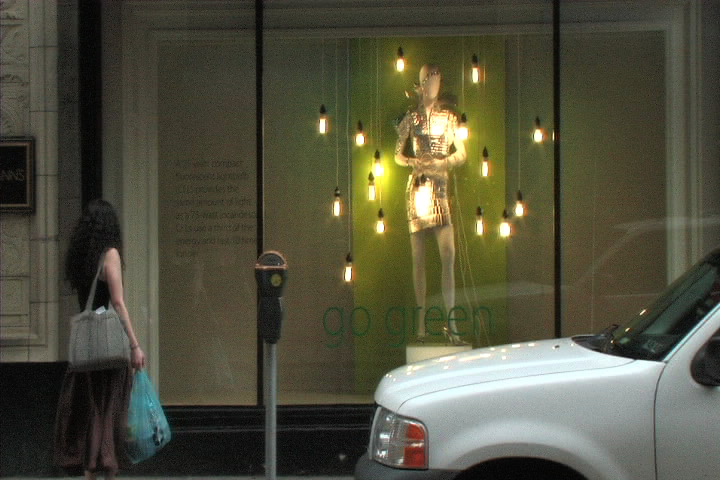
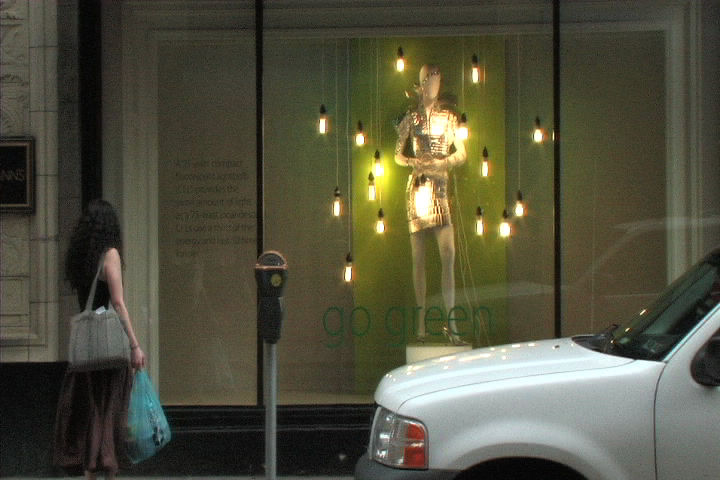
photos: screen shots from Sust Enable
graphic: “Sustainable Development,” by Johann Dreo, under a Creative Commons 2.0 license
Robin Shreeves
Hey, I’m provocative. Who knew?
Caroline – If you somehow found an implication in my article that corporations need not be responsible for their environmental impact, it wasn’t intended. They need to be making sweeping changes.
My point, however, was that consumers shouldn’t expect the corporations to be the only ones to be responsible. Sitting back and allowing advertising and product packaging to tell you what’s what is a bad idea. Many of the respondents of the survey are willing to let this be this be their environmental schooling.
In order for consumers to call corporations out on their practices as you suggest, the consumers need to be informed and see it as their own responsibility to educate themselves from less biased sources.
The responsibility of making environmental changes lies with individuals, families, corporations, governments, houses of faith, community groups…
For any one of those to abdicate their responsibility to another is counterproductive.
cchiovitti
Aboslutely!!! It HAS to be widespread simply to address the practical concerns – like cost. Unfortunately (with just having to do my kid’s back-to-school shopping), many “responsible” purchases are just out of our reach. I cannot afford to buy all organic clothing, or eco-friendly school supplies. I recently wrote a short blurb on squidoo about eco-friendly school supplies and most of them are more than triple the cost of the imported cheap-o’s. It’s across the board, though. Whether food or clothing or household items (even recycling costs money in some areas), most eco-friendly choices are way beyond the average American’s income. I get around this by self-recycling (ha ha, I mean hand-me-downs and thrift stores for clothes), supporting our local, organic, pick-your-own produce farms (which are a lot cheaper than buying in the store), and just choosing which things give us the most bang for our buck. There will come a day when these things are so common-place that prices are more in line with what the average consumer can afford, and that will be a happy day indeed!!
Tim
Unfortunately, with the ubiquitous greenwashing we see at the moment I think it is increasingly difficult for the consumers, the individuals, to make informed decisions and educate themselves about their environmental impact. People buy green because it seems cool, and they feel like they are being environmentally friendly, when in fact they are mostly contributing to the deleterious consumerism that afflicts our society. I fell like environmentalists need to come up with a new buzzword other than “green” or “sustainable.” These concepts have been hijacked by commercialism. The whole point of the green movement is to promote more critical awareness, but the “green” relationship between individuals and consumers as we see it now does nothing of the sort. Perhaps it’s time to critically evaluate What Is Sustainability?
Nick Hein
Good morning,
With as far as we are from sustainability, it’s easy to overlook that it isn’t the end goal. Becoming sustainable just means that we stop killing ourselves. Beyond that we should recognize the further goals of…
Restoration: Bringing our environment back to a state
that respects the presence of all other life forms in spite of human presence.
Optimization: Making it better than it could have been without human presence.
Sustainability, Restoration, Optimization should be our long term plan and we should work on them all at once since they are all ultimately necessary. There are certainly enough of us to divide the tasks and start working once we stop fighting.
Nick Hein
Morgantown, WV
Nick Hein
Good morning (again),
Just another quick comment about corporations. Corporations often respond more positively when you point out that a business plan that kills its best customers will ultimately be untenable.
Nick Hein
Morgantown, WV
Meryn Stol
Caroline, it seems that your experiment has left you with much wisdom. I think you have made a change in consciousness that many environmentalists need to go through.
I’ve got a blog recommendation for you, La Marguerite. Marguerite has been exploring behavioral solutions for some time, but recently she has taken a closer look at the business and political side of things. It’s important that we know where we can best focus our efforts.
http://lamarguerite.wordpress.com/
Caroline Savery
Robin,
Thank you for your response! (to my rebuttal-of-sorts). I think your points are right on, and upon review, I see how you conclusion–that consumers must take it into their own hands to learn about corporate practices–is voiced in your post. My first reaction to the post was an emotional one, and it glossed over the content of your piece. For that I take full responsibility!
I agree that it is crucial for an independent, democratic force of informed consumers to learn about and further influence corporations with what they learn. Greenwashing is definitely a problem for those who would like to be eco-consumers.
On the other hand, I know from experience how exceedingly difficult it is to even get access to unbiased information about corporate practices. Many, many corporate manufacturing procedures are protected by laws known as “trade secrets,” and environmental agencies who advocate for more information are pitifully ineffectual against these behemoths–made all the more powerful as the government hands more and more control over to corporations. Moreover, corporations have powerful “think tanks” that work to influence public opinion in devious ways, such as creating the image of “unbiased research” by a panel of well-paid scientific charlatans–most insidiously used to discredit global warming for the past decade. (Check out “Trust Us, We’re Experts!,” an illuminating book by Sheldon Rampton and John Stauber.)
For the individual to become thoroughly educated on only one set of companies (like toilet paper manufacturers, for instance) I’d reckon it’d take the average person as much as weeks of nightly internet research to claim a decent perspective. Layers and layers of disinformation exist at every turn. Are you willing to commit that time to such an activity… or should it be easier for consumers to even ASK questions of their producers?
When it comes to the little individual going up against the monster corporation, in any regard, the odds of success are infinitely small. With or without accurate information in hand. It’s time to start taking that excess power OUT of the hands of corporations and putting it back into the people’s. Then we can talk about democracy. Then we can talk about sustainability. Then we can talk about consumer choices! And it seems our greatest resource is not our dollar. It’s our laws.
Dave C.
Being relatively new to the sustainable way of thinking, I’m learning very quickly the kind of struggles you’re referring to. I openly admit that I’m kind of a brute when it comes to living green, looking at the subject more from a consumerist stand point. I know I’m going to buy things, but I’m thinking more about the impact of my purchases.
One thing that’s become perfectly clear the lack of mass consumerism has a two-fold (maybe more) affect on green consumables, lack of innovation and high cost. Take sneakers for example.
When it comes to innovation, Nike pushes the limits. They recently created a shoe for US Olympians that is remarkably light while incredibly strong and supportive, and they’ll sell tens of thousands of these shoes across the planet. On the other hand, manufacturers of completely sustainable shoes show very little in the way of innovation and aesthetics and they typically cost as much if not more than their mass produced counterparts.
Supply vs. demand is obvious when it comes to cost, but when you’re not getting input from your customers on a mass level, you’re not constantly reaching for that better product. Can a sustainable shoe be ultimately functional as well. We won’t know until more people hop on the green bandwagon even if it is more about trends than altruistic reasons.
It is virtually impossible to live 100% sustainably and I don’t see it ever happening en mass within our lifetime. The radical “greenies” are going to be disappointed, but consumers and the manufacturers have to meet somewhere in the middle before hardcore substantial changes can take place.